
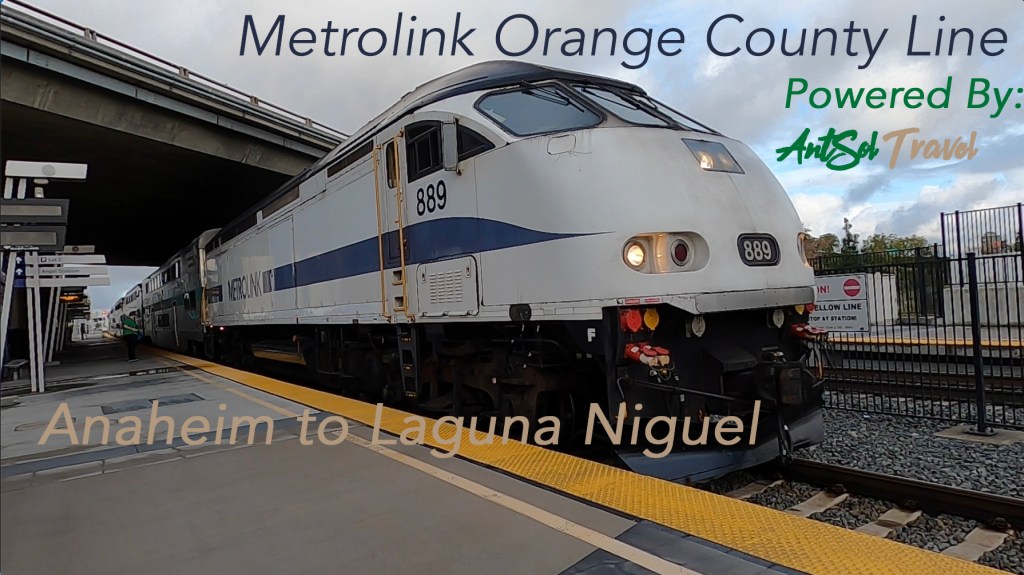
From Anaheim, next is Orange going through industrial areas and then to Orange passing through Chapman University & Old Towne. The city was founded in 1871 and was built out from the circle of the old town, just a couple blocks from the Orange train depot. Most of Southern California was primarily farm and ranch land when the land was allocated during the Mexican Land Grants. What is now Orange County, had many citrus fields, which gave the county the name. Most of the fields were sold off to developers in the 1960s, with rapid suburbanization of the land due to the freeways and cars getting cheaper during the time. This is partly the reason why most of SoCal is so spread out and baffles many guests from denser areas, such as the North East of the United States or Europe.
Next is Santa Ana, the county seat, passing by older residential areas built in the 60s and 70s. In downtown Santa Ana, Orange County Transportation Agency (OCTA), the transit and transportation planning for the county, is finishing work on a tram line that goes through downtown, with an opening date set for 2023. At that point, it would be the only light rail service in the county, as Amtrak and Metrolink are heavy commuter trains. Since this is the county seat, the county staff would get off here.
The next two stops are Tustin and Irvine. Both cities were part of the land grant and ranch land that James Irvine & his ranch partners bought or received land and worked on. After his passing in 1886, his son James II inherited the land and established the Irvine Company as an agricultural company and then still ranched on the land. In World War II, the Irvine Company sold land in Tustin for blimp hangers and in Irvine the El Turo Marine Air Force Base now the Great Park. Both facilities were decommissioned in 1999. In 1953, Jamboree Road was built as an expressway to the National Scout Jamboree that was held at the now Fashion Island Shopping Center in Newport Beach, as the road was used as a connector to the campgrounds from train stations, such as Tustin, which is right off the road.
After World War II, many people wanted to move to Orange County and have a family, as well as the Boomer generation, was getting ready for college. The University of California system bought the land for what is now UC Irvine in 1961 for a dollar. With the influx of students, the Irvine Company shifted its focus from agriculture and sold its land or built on its land for development. It was master planned from the ground up for the city of Irvine to be an ideal suburban community since they had full ownership of the land.
Both Tustin and Irvine are home is many offices such as Blizzard Entertainment & Taco Bell, as the Irvine Company built many office buildings, warehouses, commercial sites, and housing development to incentivize companies to move or add a new office in Irvine. The majority of passengers disembark at those two stations due to that, and the OC Bus and local Irvine shuttle, iShuttle, get commuters to their last miles to their workplace.
After that is the final stop of this train, Laguna Niguel/Mission Viejo. Like Irvine, these cities are master-planned by Cabot, Cabot & Forbes. The majority of the housing stock when it was first built in the 1970s and 1980s are single-family homes with an occasional apartment or condo complex. Around the same time, Saddleback College and the Shops at Mission Viejo were built.


 AntSol Travel